The Trojan Horse is a great place to hangout

The Trojan Horse
How can neighborhoods build spaces that center their community?
Millions of Americans live in neighborhoods without a spatial-cultural-spiritual center. Metropolises like Phoenix, Dallas, and Las Vegas sprawl like pancakes, with cars, highways, and cheap land spreading cities outward rather than upward. Subdivided by our cells, suburbs struggle to support vibrant cultural cores: gathering places where neighbors can hangout, be entertained, and mix stories with one another.
As Scottsdale Mayor Lisa Borowsky notes, low density development is a key perk of Scottsdale living. However, many lament about the lack of easily accessible culture and entertainment beyond fast-casual dining and fast-fashion shopping. We are surrounded by hundreds of things to do, yet no option feels all that compelling. We live among thousands, if not millions, of fascinating people, yet find it impossible to connect with them. We long for what center-less living fails to provide: a local source of community creativity, entertainment, and learning - a place where everybody knows their name.
In this report, I describe 7 virtues of shared spaces that help ground communities around their spatial-cultural-spiritual center. I then introduce a concrete example of such a space I call the Trojan Horse.
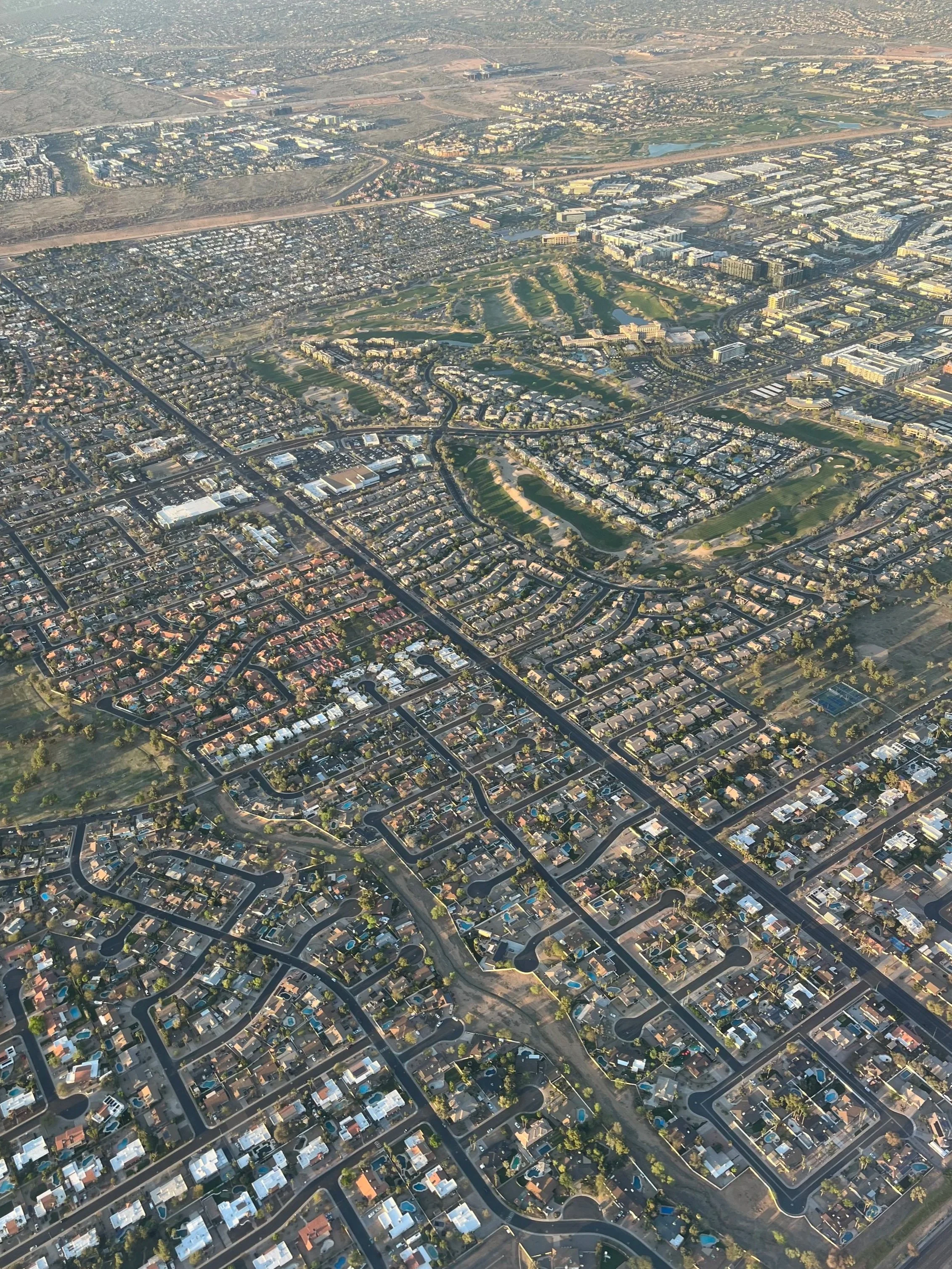
North Phoenix from above. Can you find the center of this neighborhood? Kierland golf course and Scottsdale Quarter are in the top right. Scottsdale 101 is in the top left. Land is fully developed below the canal and Bell Road (running left - right near top), and is picking up North of the 101 freeway (very top of image). 64th Street runs down the center of the image. Scottsdale Road cuts through the high-rise development in top right.
7 virtues of a vital neighborhood center
Neighborhood centers have the power to transform communities. They should have a clear purpose, be easy to build, and should integrate into local community infrastructure with minimal upfront costs. They should be located as close to as much public transportation, density, and information (e.g., libraries, universities) as possible, and leverage development trends to fit neighborhood needs.
Virtue 1 - 15 minutes away from many neighbors - An effective center is located near the physical center of where the people in the neighborhood live. Its offerings should prioritize customers who live near-by and can reflexively frequent without a stressful commute. The core base of customers should be a 15 minutes commute away by either foot, bike, public transit, or car. The summation of residents within this range constitute “the neighborhood” the center is designed to serve.
A vital neighborhood center should be built around public transit to the best of its ability, and should be easily accessible to other business to support a broader ecosystem of commerce, governance, and education. This virtue prioritizes building neighborhood centers close to walkable downtown cores near rail lines and university buildings, so the space can serve as a natural touching point for the many types of people who live near there. In future reports, I will explore how different mixtures of neighbor-commuters (e.g., prioritizing foot traffic over car commutes) should shape the offerings and design of a neighborhood center.
Virtue 2 - Social center of neighborhood - A vital neighborhood center creates opportunities for social networks to grow across various lines: class, religion, political affiliation, and identity. They forge both local connections among neighbors and global connections with visitors. Built connections can be familial, friendships, creative partnerships, or commercial conspiracies. The furniture and layout of a neighborhood center should invite these connections. For example, thin tables can bring conversations closer together, while shared tables can mix social groups. Media systems and information technologies can also be built to extend the social reach of a neighborhood center — the center’s “clout.” Subtle interventions can further increase social mixing and conversational patterns, which I will explore in future reports.
Virtue 3 - Simple but expressive offerings - A vibrant neighborhood center has a simple but expressive set of food, drink, and entertainment offerings. Ordering a hot tea at the bar should feel as natural as ordering a beer. Regulars can develop “their orders” like those at a diner, while enjoying media created by those they don’t generally mix with. Offerings should be familiar yet comfortably challenge patrons to explore new things, conversations, and stories. In effect, offerings should help counter narrative railroading, a phenomena where people fall into behavioral grooves and social routines that limit their mental and social flexibility (Osler, 2024).
A vital neighborhood center invites people in with the familiar, but transforms their thinking and relationships through exposure to something miraculously new.
Virtue 4 - Experimental but practical interior design - A useful neighborhood center is designed to provide customers direct access to spaces they are familiar with (e.g., laptop zones in a coffee shop, a bar with standard food and drinks), while inviting them into intentionally unfamiliar spaces if they are open to the experiment (e.g., a memory arcade, or a nostalgia-inducing theatre). The space’s design should allow customers to easily accomplish what they came into do - order a coffee, write a letter, have a meal or chat with a friend, work on their laptop, facetime their ex.
The blueprint below includes mechanisms for inviting customers into an enchantingly novel and entertaining space. Construction of furniture and walls can mirror set design construction, with walls moveable and space modular to allow for layout experimentation. This feature opens the neighborhood center into a living and breathing field laboratory, where intervention and research can guide how we design commercial spaces and shape human-computer interaction.
Virtue 5 - Open long hours - A diverse neighborhood will have residents who could benefit from their neighborhood center at different times of day. A film student may look for a quiet, yet lively space to work on a project at 11 PM, while a sweet grandma may want tea at 11 AM. To accommodate the diverse needs, tastes, and personalities of a growing cosmopolitan neighborhood, its center should be dependably open and strive to offer its entire menu of food, drink, and entertainment offerings. 24hr diners are a dying breed in Los Angeles, and are even harder to find in Phoenix. This is to the disappointment of many.
Virtue 6 - Subversive taste - Nostalgia is the silent force guiding culture. MAGA makes this longing explicit in political media as Hollywood has entered an era of replications, repeats, and remember-whens? Nostalgia drives consumer behavior and should be leveraged, but its pain should not serve kitsch. The pain of things passed should be transformed into an optimism for what we can create right here, right now, together. That is a primary feature of a vocal neighborhood center. For example, one way to mix people from different backgrounds is to create cultural products that mix their nostalgias into a new story. If you want to create a conversation between a 26 year old and a 62 year old, a story that pulls from early nickelodeon cartoons and latch-key kid tropes could create sticking points between the two sets of memories and lived experiences. But of course, these themes must be communicated tastefully.
Taste distinguishes which cultural products are kitsch from those that are transformative, rich, and “sticky”. The taste of a neighborhood center should be not be seen anywhere else in the world, because it is the local taste of those who populate that center. At first glance, the aesthetic of a vocal center should be completely familiar to the neighborhood, but if the customers looks closer, they will encounter details that challenges their norms and preconceptions of their neighborhood. I will explore how taste, subversion, and nostalgia shape minds and media in more detail in future reports. In terms of practically defining a taste, a lot can be achieved through careful media curation and interactions integrated with exposed lighting, metal, wood, and concrete. I highlight some of these considerations in the blueprint below.
Virtue 7 - Human centered, technology welcome - As an avid laptop user, nothing is more off-putting than buying a $6 coffee at a cafe to find an open seat at a table with a sign reading “LAPTOP FREE ZONE”. And as a people lover, nothing is more discouraging than going to a coffee shop to meet someone new, and seeing all of these cool-looking people with their beautiful faces bathed in blue light, ears plugged with AirPods. How can a balance between screens and faces be struck in bars, cafes, classrooms, and office buildings? I have asked this question to dozens of people, and 100% of the time their answer is: it can’t be. People want to be separated by their screens. They don’t care to connect with others, for reason X, Y or Z. I refuse to believe this. A neighborhood center ought to challenge this assumption, while allowing people to freely use their screens for work, out of space conversation, and media consumption. They key is to design a space such that screens are welcome but don’t dominant the scene. Interior designs should embrace new forms of technology for connection, learning, and entertainment, while challenging the idea that we can only network through Apple devices.
In future reports, I will explore what types of technology can facilitate a departure from Apple screens and their toxifying social media and political spectacles. Future reports will explore how screens have became the sole communicator of our stories, and will propose local mechanisms and technology plans that can help people connect face to face. Such technology can be as simple as giving some people screws and others nuts, and asking them to find their partner in a memory arcade. In spirit, new forms of technology should be created by and for the neighborhood. Doing so naturally sets boundaries around how technology and screens from California interface with neighborhoods in Arizona.
Blueprint for the Trojan Horse
Trojan Horses are economically vital, culturally generative shared spaces that can easily slot into current developments — strip malls, vacant gas stations, university campuses, living rooms. They foster local economy and neighborhood connections through sharing food, entertainment, and space. Trojan Horses help people turn their neighborhoods into cultural centers with traits not seen anywhere else in the world. The prioritization of local, natural character exists in stark contrast to the dominant forms of city-branding seen today, which rely on social media representations of authenticity and local character to attract residents and drive economic growth (D. Banks, 2023: The City Authentic).
Rather than optimizing for profit, Trojan Horses are systems where individuals and communities come to see one another, feel nourished, and be entertained. Through careful design of space, media, and technology, a Trojan Horse can transform a neighborhood’s economic and cultural core by letting residents express their narrative agency and define their neighborhood’s unique character.
Importantly, the Trojan Horse I describe is one of infinitely many. Trojan Horses are nothing new and take many familiar forms. They are your favorite coffee shop or library, the driving range, bar, or movie theatre; your grandma’s kitchen, your best friend’s couch, or the sidewalk; restaurants, studios, music venues, nickelodeons, play theaters, parks, preschools, and so much more. They can be profitable establishments and are often vital neighborhood centers.
Below is a blueprint for the Trojan Horse: a café, arcade, movie theatre, and story studio designed to satisfy our modern and ancient desires for connection, entertainment, and knowledge — a scene never seen before. The design presented here considers how patrons use technology while in the space, and how technology can hinder or facilitate face-to-face conversation. The design is not preachy or cop-like about letting people use their screens, but it doesn’t allow screens to dominate the scene.
Blueprint for the Trojan Horse. Furniture layout and use of spaces balances screen use and interaction type. A public, high-traffic area near the entrance allows for screens to be used - think of a cafe like Lux. Users can keep their phones in their pockets, or place in a cell for free game tokens, and enter a lower traffic (speakeasy) space.
Example display of a memory arcade game. The user uploads an iPhone album where images are positioned based on their visual content and language. In the arcade, you encounter an interactive display that maps iPhone photos onto the wall based on the content in the image. Imagine a social platform, where users upload their photos and others can interact with and download other’s uploaded photos, which can be mixed with others who map their pictures onto the display.
In the next report, I describe a user story of how neighbors could interact at a Trojan Horse.
