Cars are the original sin
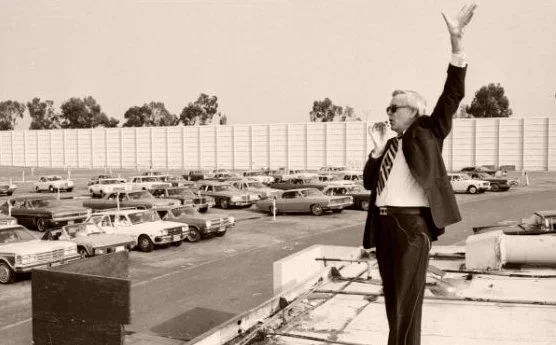
Robert Schuller preaching to motorist congregants in Southern California. Image credit.
Americans worry about technology’s negative impact on our psychology and relationships, but the real culprit isn’t what most believe.
Many focus on the impact of phone screens and social media on our children and politics:
A recent review of psychology studies found that watching short-form media content will reduce people’s attention span (Nguyen, et al., 2025)
Counselors specialize to help children with screen addiction (PBS)
Pastors interpret scripture to help guard against ‘digital dangers’ (Life.Church)
Polarization is inherent to social media (Science)
The bottom line: Screens became intermediaries of our communication and relationships because most Americans live in isolated, car-centric neighborhoods. Cars are the root cause of our alienation, screen addictions, and polarized politics.
Why it matters: With church numbers on rapid decline, it is crucial that we devise novel solutions to improve psychology and communities. However, we must address the root cause of our issues. Screen dependency is the result of how our neighborhoods are built. This article describes how cars shape our psychology and communities and links readers to possible solutions to improve the issue.
Most American neighborhoods are built around cars, not people
Suburbs are built more around the car than the single-family home. Cars route neighborhoods and define how we interact with those we live among. They shape how we satisfy our need for community, entertainment, intimacy, and conversation (Building Suburbia).
Freeways connect the suburbs to downtowns. People travel away from their home so they can consume urban culture from those who live where community and creativity prospers. Meanwhile, in the suburbs, garages and driveways consume up to a third of a home’s footprint, and patios disconnect outdoor gatherings from neighbors. Front porches connect families and tie them to an amorphous, but very real, neighborhood center. Many master-planned communities are organized around private green spaces including backyards and golf courses, while devoting shared space to driveways, highways, and parking lots.
Cars cut communities up at our joints. They limit healthy congestion that invites people to align their ideas and stories. This is not to say that cars don’t create congestion. During rush hour, LA’s 405 or PHX’s I-17 are among the most heavily visited shared spaces in the world. However, interacting with others is a matter of survival rather than healthy interaction and social connection.
Now, consider rush hour in Renaissance Venice. Merchants, artisans, lawyers, scientists, priests, and craftsmen crossed paths in piazzas and along canals after their day of work. Bumping into one another, they didn’t bring out insurance cards, but rather they exchanged ideas, debated politics, and grew culture through face-to-face conversations across socioeconomic lines (The Great Good Place).
Subdivided spaces train us to rely on our screens for connection, relationship, and entertainment
Strip malls, big box stores, movie theaters, restaurants, and malls are the shared spaces of the suburbs. Enter a coffee shop, restaurant, or bar and look around. You are confronted with people in private parties or deep in their screens. Conversations are tough to start if someone wears headphones, bathed in blue light. It feels intrusive to strike up conversations with people that sit at tables which physically separate them from other groups.
These trends have only accelerated since the pandemic. Remote work and food delivery robots invite people to never leave their homes. Living lives of isolated consumption.
The shared spaces that suburbs do support are often built in such a way that interaction with people outside one’s own party is nearly impossible. The demographics of any given space are also highly homogeneous: people of the same age, race, or class tend to be present. The interiors of these shared spaces mirror the structure of the suburbs themselves. Consider three examples
In restaurants, people are subdivided by tables and consume personal meals arriving on individualized time frames.
In cafes, many people are working on their laptops and are cut off from those around them.
In movie theaters, everyone is a passive consumer of the film, with no space or devoted time to converse with other people before or after.
Of course, many people like this setup, me included, and there are plenty of options for these types of activities. The structure of these activities are built around the fantasy of the car and the freedom it grants. However, it reinforces general patterns of alienation that drive people toward their phones. Freedom often leads to a lot of personal alone time, and a phone removes any boredom in that emerges in that personal space. Even a small percentage of spaces devoted to new forms of entertainment and social mixing could shift behavior away from cycles of phone dependency.
What can be done?
People will feel more supported, our stories will enchant us and grow our attention, and our government and religions will better serve us, if we build spaces, rituals, and networks that increase neighborhood interaction. We can’t rely solely on rebuilding cities into walkable networks of healthy congestion and local culture.
Furniture design can invite people to strike up conversations with new people
Multi-generational jam bands can help the youth connect with elders
Public lectures can invite dialogue with community members and experts
We must creatively reimagine how existing environments can foster more mixed interactions, storytelling, and learning. The 7 virtues of Trojan Horses article describes how a specific type of shared space can help neighborhoods center their stories, communities, and politics. Trojan Horses can help families balance technology and screens in their homes. Trojan Horses can also help communities build rich social connections in car-dominated cities.
